Wednesday, December 28, 2011

SWTOR: A New MMO

Greetings friends and strangers,

I am the enigmatic Rob-in-hood. I am here to take you on the journey of a world yet to be fully realized: the video game Star Wars: The Old Republic.

From what I have played thus far, it is a truly outstanding game. The opening cinematic is very outstanding as it starts off in a starport above a planet and shows a couple of jedi masters escorting a smuggler to a cell after he was caught trying to smuggle ancient sith artifacts. After one of the jedi feels something bad in the force, a huge fleet of ships come out of hyper space and begin firing on the starport. Right away, two sith warriors board the starport and attack the jedi in a very acrobatic fight. In the end, one of the jedi masters must flee while the other sacrifices himself. It’s a very beautiful cinematic, but beautiful cinematics are industry standard now. The cool thing about this game is that when you choose an allegiance, you are treated to another beautiful cinematic which highlights the strengths of whichever side you have just chosen. Again, the cinematics in this game are just icing. Fortunately, the game itself makes the icing look lame.

After choosing your class (4 on each side) and race (4 or 5 options within each class), you can customize your look. Now, I have to say that this was one of the coolest features I had seen from a new MMO in a while. While there are MMOs that allow you some changes made to your body type, few give you the option of making your character overweight. While that is not exactly a selling point, it was one of those ‘hahaha, that’s cool!’ moments. Now, if you’re going through the character creation process, I highly recommend you make a character that looks good. Most times when playing any MMO, you create a character and give little heed to his facial features. Some people get really into it, but for the most part, it’s something you can ignore completely. With SWTOR, however, if you created an ugly character during character creation, you will be looking at and suffering through your ugly character through every in game cut scene. Take from my experience … after 5 levels of watching an ugly character talk for you, you will regret not taking an extra few minutes to make him more to your liking.

After character creation is finished and you have a character you can stand to look at, you are treated by the lip curling sound of trumpets blaring as the wall scroll appears from the bottom of your screen and begins to relay to you the story of your character and his role in the world. You immediately are thrust into a grand storyline, depending upon your class, and all written directly towards the class. For example, smugglers start out with dropping off a cargo shipment and their ship ends up getting stolen. Bounty hunters are told one thing when they start … become notorious. Imperial troopers are on an infiltration mission. All class quests are very appropriate.

For the purposes of this review, I shall be relaying the tales of Robear, Imperial Agent. I started off on the planet of Hutta, a planet obviously run by the Hutt clans, and I am to infiltrate their clan and suggest they take up arms against the Republic. The game play is fairly standard to most any other MMO. Attack with enemies with powers, loot bodies, rinse, repeat. It’s a very familiar system. The main driving force in this game is the storyline. BioWare built this game around being a story-driven MMO and they excel in spades. Any quest you pick up is not a simple “quest giver tells you to kill 50 rats”, but is instead a treat of an interactive experience. Getting a quest puts you and whoever else is in your party into a cut scene where you can make decisions for what you respond to the NCP with. If they say “I’m injured and hurt”, you can call them a coward or you can offer to help them. Your responses don’t affect your quest (that I’ve seen), but they can affect your companion’s relationship with you, though, during the first 8 levels, that is irrelevant. There is a system in place that gives you light side and dark side points for your responses, but your light side and dark side points only affect social items and titles.

All in all, from what I’ve seen thus far, the game is well made, fresh, and extremely fun to play. It brings the addiction back into the MMO experience. And just so we’re clear, this is only the first part of my review. More to come next week!

For all those who are now enticed to purchase the game, you can order it here: Star Wars: The Old Republic.

Monday, December 26, 2011

Something something 'dark side'

Greetings to the intrawebs!

I am Rob-in-Hood, enigmatic ruler of my chair and lord of my pants. I have been carefully selected from the very short and diminishing list of people who Jim has not yet chosen to destroy to bring you all news and knowledge of a new game that has enter the video game market: Star Wars: The Old Republic.

I am a fan of the Star Wars franchise, though I don't think I am a diehard Star Wars fan. Video gaming is a passion of mine, however, so hopefully my experiences with other games will allow me to shed light on this new game and give an accurate portrayal.

My postings will begin this Wednesday, December the 28th. See you all then!

-=rob in hood=-

Tuesday, December 20, 2011

The Ark Addendum - Phoenix's Transform

Hello, intrepid Transfans.  This week's Ark Addendum was inspired by last week's offering.  It seems like a while since I've done an extended Masterforce Transformation sequence, so here one is.  Naturally, I chose Phoenix.

As usual, the designers did a kick-ass job with this, lots of motion and excitement.  Note how many of the models break from the panel.  They just can't be contained.  I also like the speed lines in the final panel. 

Thursday, December 15, 2011

Death’s Head Review: What If #54: What if Minion Had Not Killed Death’s Head?

The final appearance of Death’s Head (for a dozen years, at least) came in the pages of the ‘What If’ series. The old creative team is reunited – Simon Furman writer and Geoff Senior artist – with Janice Chiang letters, Sarra Mossoff colourist and Rob Tokar editor.

The cover, also by Senior, is big and brash: an over-muscled Minion goes toe-to-toe with a spikey-armoured Death’s Head. Beneath them are items from fallen Marvel heroes: Captain America’s shield and War Machine’s helmet. The caption asks, “What If … Death’s Head I had lived”, which does the job, although I would have added a question mark, and using a big, thick Roman numeral does immediately make you assume it means “Death Head II” (which makes no sense).

It’s a strong image – both protagonists are tearing into each other – although nothing like as gory as some of the Death’s Head II covers. Minion’s blade looks to be doing no more than surface damage to Death’s Head’s face, while the mechanoid’s fist appears to be punching into pink jelly, rather than flesh. Death’s Head’s legs are also bent at an impossible angle, just to fit them into the frame.

Manhattan 2020. In film-noir style, Dr Necker is walking through a dark, rain-streaked alley in a hat and trenchcoat. She rendezvous with Spratt, who introduces her to Death’s Head, rebuilt after his near-death at the hands of Minion. We are treated to a full splash page of the mechanoid’s third uniform, which mostly consists of enormous arms, extra guns and lots more spikey bits. His head is unchanged and looks quite small atop this titanic construction.

Necker reveals that Minion has (somehow) become a liability for A.I.M. and offers him the chance for revenge. Though angry at Necker for setting Minion after him, Death’s Head is prepared to listen – but not for free. As Spratt reminds him, there’s no profit in vengeance.

The narrative is picked up by Uatu the Watcher, who reveals this prologue to be a ‘What if’. He recaps the story of the Death’s Head II limited series, then speculates what would happen if Death’s Head had teleported away a split-second before Minion killed him.

In this universe, Minion forgets about the escaped Death’s Head and goes on to assimilate and kill his next target, Reed Richards. However, without Death’s Head’s body for Strucker to possess, there can be no Charnel, so Minion is left waiting for a threat that never materialises. Instead, Strucker lures Minion into a trap and possesses him instead. There follows a classic sci-fi monster-attack sequence where Minion/Charnel destroys an A.I.M. installation.

This brings us up-to-speed with the prologue: in a shipwrecked freighter that serves as an atmospheric office, Spratt is counting out Necker’s money as Death’s Head accepts the contract. He requests use of a time machine and a really big gun.

Travelling back to 1992, Death’s Head convinces the grief-stricken Fantastic Four Three to help him, since all that remains of Reed is now trapped in a killing machine. Using similar powers of persuasion, he recruits Captain America, War Machine, Luke Cage and Namor to his cause. Necker is impressed at gathering so much power for free, which Death’s Head attributes to his understanding of the ‘super-hero mentality’.

We jump straight into a full-on superhero dogpile on Charnel. They land some good hits on the creature (I especially like Sue Richards’ nasty method of creating a force-field inside Charnel’s body, then popping it), which concludes with Thing dropping a building on him.

Of course, this has only succeeded in making Charnel mad! Having adapted to the attacks, he fights back, killing the heroes in quick succession (once again, a special mention for his means of dispatching War Machine – a narrow blade configuration through the eye slits).

Death’s Head has so far remained on the sidelines, allowing the superheroes to sacrifice themselves, so Charnel is worn down (something Necker views with admiration). He now steps forward, toting a gun the size of a Buick, and blasts Charnel. He follows up with an attack that uses everything in his arsenal, including gouging Charnel with his tusks. Though outmatched, Death’s Head goads Charnel that he is too thuggish to access any of his 105 personalities to win the fight.

Charnel takes the bait and taps into Reed Richard’s intellect to ensure maximum suffering for Death’s Head. Before he can strike the final blow, he freezes, allowing the mechanoid to decapitate him. The escaping energies cause Charnel to spectacularly explode.

In a neat reversal, Death’s Head is left holding Minion’s skull. He explains to Necker and Spratt how he tricked Charnel into giving control to Reed Richards’ personality and ponders the nature of heroism, “Struggling against impossible odds, risking almost certain death to help those in trouble … I just hope it’s not catching, yes?”

It’s a fitting swan-song for the character. Death’s Head is allowed to show off his sardonic, cool, ruthless personality for the last time, as well as being granted a plausible victory against his nemesis, using cunning rather than brute force. And at the story’s end, he finds himself no wiser or nobler, with just a shrug for fallen comrades and an eye for the next paycheck.

Furman admitted that he found writing this to be a “deeply satisfying and cathartic experience”. Aside from sparing his creation at the expense of its successor, it does give him the chance to demonstrate how he would have written the all-superhero brawl against Charnel. Though hardly original, I liked the battle. There were some nicely inventive ways for the heroes to attack (and get killed) by the monster (compared with the fairly blunt methods used in 2020 Vision) and Death’s Head stays in character as a cynical manipulator. It could be argued that Minion is also in character as a superpowered machine that can’t be beaten by any other Marvel superhero, even some of the greatest, which may also have been Furman’s point.

Though clearly favouring Death’s Head, Furman does a good job of working with the established story: Strucker’s grudge against A.I.M. is maintained (and expanded upon, given we actually get to see Charnel destroy some installations in this version) and the inclusion of Reed Richards as target #106 is good continuity. It also makes for a satisfying twist: Death’s Head gives Reed’s personality control over Minion, just as Reed gave Death’s Head control over Minion in the ‘true’ story.

Senior’s artwork is very good, though a long way from his best and perhaps his art isn’t suited to the reduced colours of the US print. His depiction of movement and action is still great, however, so there is plenty to enjoy in the explosive, brutal slugfest against Charnel (although I wasn’t convinced by the squishy pink-gore of the cyborg’s insides). Charnel’s attack on the A.I.M. installation is also very well handled – single-frame depictions of the sudden assault that match the pace of the text and keep the attacker out of view until the final reveal.

Death’s Head’s new look is a parody of the fashion for big guns and big muscles, but Senior keeps the augmented mechanoid looking formidable, rather than ridiculous. Compared with the bloody and overly-detailed work of the Death’s Head II series, the artwork already seems to be out of step with its contemporaries, but it’s certainly no worse for that.

The What If #54 was republished ‘Death’s Head Volume 2’.

Tuesday, December 13, 2011

The Ark Addendum - Phoenix's Truck

Listen up, true believers!  It's another installment of The Ark Addendum.  After four weeks of cassettes, I figured it's time to go back to Japan.  Trawling through my archives and what did I find but Phoenix's truck!

I enjoy the designs of Masterforce, as a rule, especially the props.  This one is kind of an odd one.  While Masterforce nominally took place in the future, most of the aesthetic seemed to draw from the present day.   This truck is a bit of an exception.  It seems like it would be home among the vehicles of someone like, I dunno, Victor Drath from S3's Only Human.  Enjoy!

BTW, the signing went very well.  I'll post up some photos in a bit.  It was great catching up with Mike, Livio, Marty, and some of the TF Prime folks. 

Thursday, December 8, 2011

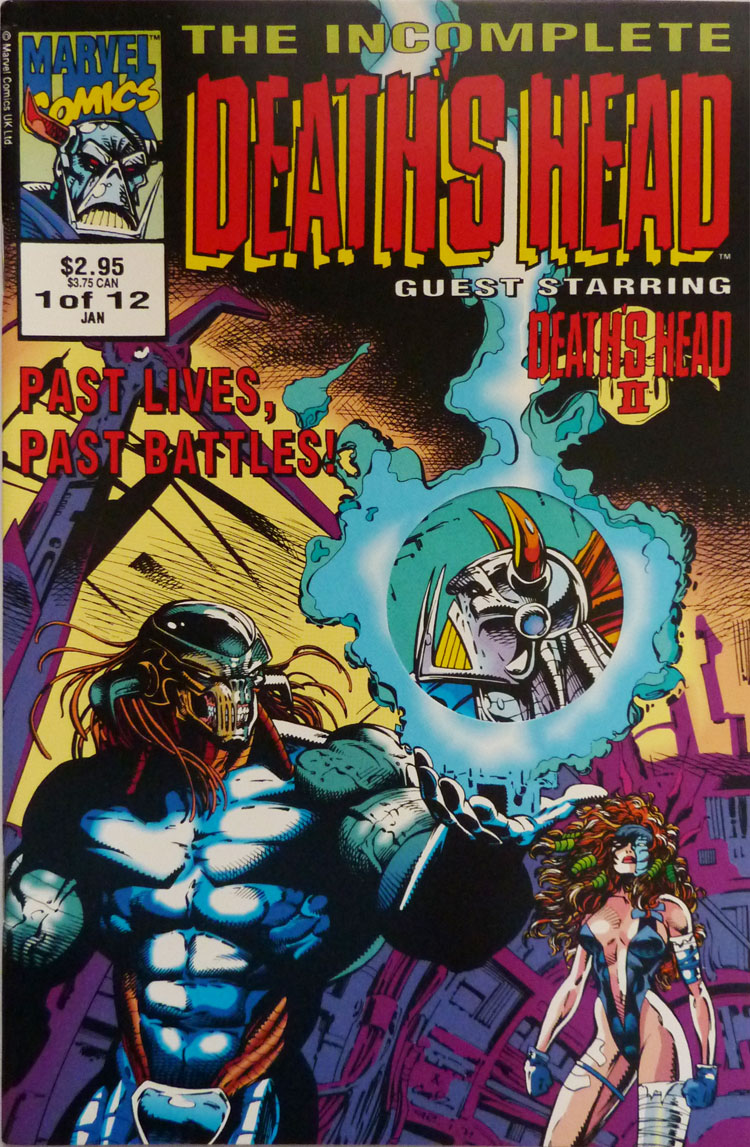
Death’s Head Review: Doctor Who Monthly #173: Party Animals & The Incomplete Death’s Head #1-12

For this, I’m attempting the rather-ambitious goal of thirteen issues in one review. The Incomplete Death’s Head series was published around the launch of Death’s Head II. It reprinted most of the original mechanoid’s tales, and was given a framing story featuring Minion and Tuck.

The Doctor Who Monthly #173 was published two years earlier. It has practically nothing to do with Death’s Head, except for its puzzling inclusion in the ‘Death’s Head Volume 2’ collection. It only really makes sense when it was retroactively included in the framing story, which is why I include it here.

The framing story of The Incomplete Death’s Head was written by Dan Abnett, pencils by Simon Coleby, inking alternated between Simon Coleby and Neil Bushnell, lettering was either Annie Parkhouse or Gary Gilbert, colour David Leach, and the editor was John Freeman (also credited with the ‘plot’ for issue 1, so I guess this was his idea).

The cover to the first issue is by Liam Sharp and Hank Kanalz, and it’s quite a good one. Minion poses dramatically (behind him, Tuck just poses) and examines a glowing sphere that contains a portrait of Death’s Head. The real treat is that the sphere is a cut-out circle and the cover opens, like a pop-up book, to reveal the rest of Death’s Head facing many of his enemies: Mayhem, Big Shot, Plaguedog etc. Everyone is charging towards the mechanoid and, though I have my usual reservations about the way Sharp depicts movement, the whole image would make decent poster art.

The story begins with Minion and Tuck unexpectedly transported to a mysterious, hi-tech location. We later discover this is Maruthea – an ‘impossible’ space station in the centre of the space-time vortex. Quickly defeating the robot guardians, they discover they are in an archive dedicated to the original Death’s Head.

With one panel, the Pyra and Lupex origin is swiftly covered (the omission of the actual story is odd, but the high standard of that story’s artwork might have been ruined in this format) and move on to the next step: Death’s Head was stolen, programmed to be a bounty hunter, and set up in business where he ran into the unfortunate Tex.

Minion plugs himself into the archive to learn more, and a missing piece is added to the Death Head story: he was stolen again and sent to a parallel universe (i.e. The Transformers universe) where his size was considerably increased. To circumvent copyright, the computer screen shows a poor quality image of Death’s Head fighting an off-colour Galvatron. The story concludes that, during this robot war, Death’s Head was caught in the gravitational well of a collapsing planet and accelerated into the Crossroads of Time (not exactly matching the original story, but perhaps easier to explain in the limited space).

After viewing his adventures with The Doctor and Dragon’s Claws, Minion is intrigued to know more about Death Head, since without that dominant personality he would never have gained his own free will. He is suddenly blasted by electrical feedback and his mind is pulled into the cyberspace of the archive.

The consciousness of Minion then meets the consciousness of Death’s Head, which has materialised within cyberspace. Over the course of the series, they both review the past adventures of the freelance peacekeeping agent, peppered with moments of action (such as when the memory of Big Shot comes alive and attacks) to keep things interesting.

In the real world, Tuck is attacked by the creator of the archive: Hob. The diminutive robot valet survived the explosion of the Dogbolter Temporal Rocket, but his master went missing. Obsessed with finding Dogbolter, and rebuilt in mechanical-spider form, Hob created the archive to study Death’s Head (although he is ignorant of the Minion incarnation). His apparent hope is to trap Death’s Head and The Doctor, in the hope that they can be made to find his master.

As Hob has Tuck in his clutches, and Minion watches helplessly, the actual Death’s Head and The Doctor both arrive at Maruthea, which segues into the Doctor Who story ‘Party Animals’ (Gary Russell script, Mike Collins pencils, Steve Pini inks, Glib letters, John Freeman editor)...

The Seventh Doctor and Ace arrive at Maruthea to join the birthday party of a satyr named Bonjaxx. The party is a crowded scene of every character the artist can imagine (ranging from a Sontaran to Captain Britain to Star Trek’s Worf to Bart Simpson). The Doctor is told that someone is looking for him, and he wonders if it is Death’s Head, who is sat alone, drinking a cocktail with a little pink umbrella.

He is then met by another eccentrically-dressed chap with a female sidekick. They chat to each other, amiably and enigmatically, as a massive brawl erupts around them. After a comment about the First Law of Time, they step into their respective TARDIS’ and reveal the not-too-surprising truth that The Doctor has just met a past/future incarnation of himself.

And back to the framing story, Hob joins the brawl and faces off with Death’s Head. Watching from cyberspace, the virtual Death’s Head points out that his past self might actually be in danger, since causality means nothing in Maruthea.

With The Doctor gone, Minion fears that Hob will vent his frustration on Tuck. Death appreciates looking out for his partner, and admits that, given the chance, he would have tried to save Spratt (probably the nicest thing he’s said about his deceased sidekick). He offers to shunt the cyborg back into reality on the condition that he doesn’t let Hob kill him (presumably because he wants to save himself for the pleasure of being killed by Minion later on).

Minion leaps back into life and attacks Hob, severing the arm that held Tuck captive. He then teams up with the real Death’s Head and the pair make short work of blasting, then slicing, Hob into pieces.

In the aftermath, Death’s Head makes some quick deductions about the cyborg who moves like him and shares his name, and decides that Minion cannot be allowed to live. Before violence starts, Death’s Head is zapped and falls to the ground. The Doctor has returned to blast him, once again, with The Tissue Compression Eliminator (which has been modified into a Deus Ex Machina device, since it knocks Death’s Head unconscious and wipes his memories of the whole encounter).

Confronted by Minion, The Doctor confesses that he was the one who sent Death’s Head into The Transformers universe, trying to bring out his capacity for good by shaping his adventures. He was also the one who brought Minion and Tuck here, so they could conclude the unfinished business with Hob. Minion appreciates the save, but dislikes being manipulated, and so warns The Doctor against doing so again (and, continuing the theme of Minion being tougher than any other comic character, The Doctor meekly accepts). Minion and Tuck return to their own time, while The Doctor helps Death’s Head back to his feet.

As a way of reprinting the old Death’s Head titles (although I’m not sure I believe the promotional rhetoric that Death’s Head II was so amazingly popular that audiences demanded to know more about his namesake), this was nicely done. Like a compilation episode of a long-running sitcom, the framing story gave Minion a good little adventure, and even filled in some of the blanks of Death’s Head’s backstory.

Minion and Tuck still in ‘tough guy and sidekick’ mode, although space is limited to give them much more scope for character. Their initial wisecrack responses to the archive reports – commenting like Beavis & Butthead – get a little tired, but once danger kicks in, things improve. I like how some reprints are used to support an argument – such as the She-Hulk episode about time-travel – rather than have the characters passively watch them.

Having Minion speak with the cyberspace ‘ghost’ of Death’s Head was a nice touch. It’s interesting that Minion only took the mechanoid’s personality, not his memories, and it helps to give them different perspectives. And I still think that Abnett writes the first Death’s Head better than he does the second one.

Coleby’s artwork gets stronger as the series goes on. The initial line work is fairly thin and insipid to begin with, but does improve once Bushnell’s inks add some depth and atmosphere to the panels. Everyone has over-emphasised guns, muscles and blades, even by Minion’s standards, but that’s nothing new. I did like the nightmarish creation of Hob: a mechanical-spider with his little round head as an angry nodule on the end of his Alien-esque tongue.

Story-wise, it was a clever move of Abnett (or Freeman) to bring Hob back into the narrative, since Dogbolter was one of the more obvious loose threads of the series. Hob’s logic about capturing Death’s Head in order to find his master is a little skewed, but I’m happy to give him some crazy-robot leeway. It also gives a good reason to bring in The Doctor and the short story of Maruthea.

As for ‘Party Animals’, unless it figured into a large narrative about The Doctor’s future self (and I don’t think it did), I couldn’t really see the point. Aside from the glimpse of a future Doctor (and given they had free rein to create anything, a middle-age man in a dapper jacket is hardly original), there’s no drama or resolution in this story. The artwork is functional, although it tries too hard to capture Sylvester McCoy and Sophie Aldred, and Collins clearly had fun in depicting a diverse range of characters.

Generally that story felt like a bit of end-of-term silliness , and only just manages to fit into the wider narrative. It’s surprising that this made it into the republished volume – since it’s hardly a Death’s Head tale – whereas the more significant framing story did not.

I’m also not convinced by the final reveal: that The Doctor has been manipulating Death’s Head’s life – as far back as sending him to hunt Transformers. Apart from its very implausibility, Death’s Head’s career has hardly been a positive one – that’s part of his appeal – and making him the puppet of The Doctor somehow undermines his story.

Next week: Furman’s revenge – as we visit a parallel universe that asks: What if Minion Had Not Killed Death’s Head?

The Doctor Who Monthly #173 was republished ‘Death’s Head Volume 2’.