Wednesday, October 5, 2011

Wingthing!!!


So, I'm perusing the news section of Seibertron.com, as I often do, and what do I spy but some listings for upcoming Sounblaster / Twincast Encore releases.  Ho hum, already got em... wait a moment!  What's this?  They come with new cassettes?  Sweet!  Twincast gets redecos of Ravage and Steeljaw, with weapons swapped, kinda neat.  And Soundblaster... Wowzes!  Soundblaster comes with redecos of Frenzy in all red as 'Enemy' and Ratbat gets an orange redeco as 'Wingthing!'


Plotz!

Let me explain.  Wingthing, if you don't know, was the little animal companion that came with Action Master Soundwave.   He was an orange and black little winged demon thing that turned into a gun.  Not bad, but nothing special either.  Still, Soundwave has always had a menagerie of animals, so why not one more.

Flashback to me working on The AllSpark Almanac II.  Derrick Wyatt gave me some of his late sketches, drawings, and brainstorming.  One of them is a pretty neat drawing of three Laserbeak repaints: one in blue, one in black and gold, one in orange.  Well, nifty!  I could do a page with them.  I came up with a story for them, ran it by Derrick, added his notes
(Originally I had it explicit that they didn't have sparks, unlike Laserbeak and Ratbat.  Derrick rightly pointed out that it was better to leave that ambiguous.)  Still, one page with three of the same image and nothing else seemed off to me.  So, I looked at Ratbat.  What could I repaint him as that would make sense?  There hadn't ever been a redeco of the Ratbat toy, nor a generic based on him.  Hmmm... Ah, yes, of course!  My old pal Wingthing!  So, colored her, wrote up a bio, and we get another piece of canon to enjoy.

So, when I see that TakaraTomy is running with my idea, I get a warm and gushy feeling inside.  Might they have done it anyway?  Of course, I'm not that big an ego maniac.  But I can't help but feel that I had a big part to play in this deco.

Naturally, I'll be picking up a copy.  

(BTW, Wiki folks, yes, I know that a lot of you guys are pretty stoked about Enemy.  I'm happy for you, but it's not my thing.)

Tuesday, October 4, 2011

The Ark Addendum - Hawk's Car

This week, we dip back to Masterforce, with some more of the props.  Hawk's car!  See, the leader of the Cybertrons, Metalhawk, had a human disguise, Hawk.  Naturally, Hawk needed to get around, so he drove this nifty little two-seater.  I've check with some car experts and it doesn't seem to be based on any real-life car.  Pretty neat, though!

Friday, September 30, 2011

Bish's Review: Marvel UK #137 "Ladies' Night!" Part 1

Ladies' Night Part 1 was written by Simon Furman, illustrated by Dan Reed, lettered by Annie Halfacree and newcoming colourist Euan Peters who went on to have a long relationship with the UK Transformers stories.

The cover is by Lee Sullivan and is quite a nice idea. It's unusual to see a human so prominently on a Transformers cover so it's unfortunate that she looks so awkward. I know comic books tend to portray an "idealised" view of anatomy but there's nothing ideal about Dr Hoffman here. Rather than athletically climbing a rope she looks like she's about to pass out from malnutrition and that's if her weirdly tight belt doesn't snap her in half first. Ultra Magnus "silent scream" is pretty well done, however, and rather evocative. It's just a shame the rest of the cover doesn't measure up.

We start on the slopes of a familiar looking mountain and are reunited with a familiar face. Dr Susan Hoffman, fresh from her clash with Megatron beneath the city of London is now investigating a new phenomenon - a volcano in Oregon, thought dormant, that has recently erupted. While there are metal fragments of unknown origin surrounding the site, I'm not convinced this really comes under the purview of archeaology, but it's nice to see the character wasn't a one off.

She descends intrepidly into the volcano and discovers, to her shock, that there are two giant robots trapped within the rock. Galvatron and Ultra Magnus, far from being destroyed by their tumble into the lava back in Vicious Circle! appear to be intact and merely frozen in place.

Meanwhile, Goldbug (who is still on the run from Grimlock's "justice" during this period of the comic), Rollbar, and Blaster are watching TV in a shop window while in their vehicle (and tape deck) forms. In a moment of cuteness that seems almost inevitable, Bumblebee is extremely taken with the story of Herbie.

Their enjoyment is cut short, however, when they see a news report about the volcano, fronted by Joy Meadows (Sludge's friend from Dinobot Hunt!). She is talking to Hoffman about the find and the Autobots are shocked to see the stricken, pained visage of Ultra Magnus, trapped within the volcano wall.

Elsewhere, Cindy Newell, Ultra Magnus' friend from the Burning Sky! storyline, dreams fitfully about that last fateful battle. She wakes from her fitful sleep to see the same news report, now hovering over the terrifying snarl of Galvatron!

In the Decepticons' island hideaway, Shockwave struggles to contain his composure at seeing at the news that the future Decepticon commander might still function. He immediately orders Soundwave to gather a squad of Decepticons and travel to the volcano, not to free Galvatron, but to destroy him!

Back at the volcano, Joy Meadows and Susan Hoffman are talking about the broadcast and the military attention it has drawn when they see another woman being manhandled as she tries to get to the crater - Cindy.

Joy orders the soldiers to release Cindy and the newcomer explains that she has to help Ultra Magnus somehow. Before she can explain further an explosion goes off close by and the threatening helicopter form of Vortex appears in the sky.

The other Combaticons also charge and engage the US troops around the crater. It's a slaughter. The humans can make no headway against the Decepticons at all.

After the army withdraws, the Combaticons are discussing their task to destroy Galvatron. Goldbug and Rollbar are listening in, concealed behind a boulder. They decide that this is one victory they can give the Decepticons and decide to leave, before a tiny determined figure appears and begs to differ.

Cindy is angry that they have decided to abandon Ultra Magnus to his fate in the interests of finishing off Galvatron. Goldbug points out that if Galvatron lives, Magnus' sacrifice would be in vain, but Cindy won't hear of it. While the Autobots retreat she determines to stay, assuring Goldbug that it isn't over yet!

Those who know Furman's later work might recall that he sometimes betrays a slightly awkward relationship with gender politics on these Transformers books but most of that will actually come later and be connected to the idea of female transformers, rather than humans. However, the Ladies Night! title of this issue is a little unnecessary as it seems to say: "That's right boys, this one has girls in! Deal with it!"

That aside, these three characters are some of the more interesting supporting characters from Furman's Transformers UK stories and it really is great to see them all again, especially after Susan Hoffman just fell out of the Action Force story with no explanation. It should also be noted that all three women are strong, independent professionals: archaeologist, reporter, geologist, and have no romantic subplot that would necessitate them being female. This is a far cry from The Girl Who Loved Powerglide. Okay, one could argue that Sludge's relationship with Joy Meadows was based on her gender's traditional role as a caregiver, but that is hardly worth mentioning, given that she was also portrayed as an intrepid, monster-hunting reporter.

It is undoubtedly contrived to group these three characters together but the connections do at least make sense beyond the simple fact of their gender. Certainly there is more interest here for a regular reader than in creating a new set of characters for this story so I think trading believability for an emotional connection is a good choice, although not one that should be made too often.

Decepticon politics are always a welcome addition to the story and I particularly like the idea that Galvatron is too much of a threat to Shockwave's authority to be allowed to live. Coupled with this is an unusually pragmatic approach from the Autobots. This is understandable as this particular group are on the run from their own side and cannot rely on getting any support against the Combaticons, let alone if Galvatron were to get loose. That said, it is surprising that Goldbug appears to be calling the shots at the crater as I might have expected to have seen something of Blaster's action-hero persona come to the fore as the Decepticons attacked.

Unfortunately Dan Reed seems to be in danger of becoming the next Will Simpson for this column as once again I find his art lets down an otherwise pretty good issue. The problem this time is not so much his style, which is generally serviceable, if out of the ordinary, but his sense of scale. Granted, Transformers and scale is not a subject that can be entered into lightly and the generally accepted response is to accept the inconsistencies and move on. However, this becomes increasingly difficult when you have images such as Swindle - a robot who turns into a jeep, picking up a jeep in one hand and shaking the humans out of it like bugs. Obviously the Marvel comic does include some size-changing (mass shifting if you want the generally accepted fan term) when it comes to characters like Soundwave or Starscream but in general the more mundane vehicles have tended to transform into a vaguely plausible upright version of their size, give or take a little artistic licence. To ignore this, as Reed does, ups the giant stompy robot quotient, certainly, but takes away a good part of the appeal of Transformers - the seamless shifting between one mode and another.

It's great to see the comic revisiting some of it's human characters as well as the robots. The Marvel Transformers universe really begins to feel like it has a life of its own as the cast expands and characters develop. And that's without even considering the possible threat of a Galvatron revival if our heroines don't stop it! Definitely a recommended issue, with a review of Part 2 coming next week.

Thursday, September 29, 2011

Death’s Head Review: The Body In Question, Book 1: Hunters

At last we get to the Death’s Head graphic novel. Published about a year after the series folded, it was also serialised in Strip, a large-format UK anthology magazine, from #13-20. As you’d expect, Simon Furman was the writer. Geoff Senior is credited as ‘artist’ (which here encapsulates pencils, inks and colours), Helen Stone was letterer and Steve White editor.

The cover is another by Walter Simonson: Death’s Head is front and centre, advancing through an alien jungle with eyes burning and mace attached. Two others stand behind him: a woman in an outlandish cape and a man in green armour and a horned and tusked helmet (that’s as far as I’ll go to analyse them, since their very presence on the cover is a bit of a spoiler). It’s a moody cover, but not a terribly exciting one. Death’s Head’s proportions are too beefy, the mace too large, and there's no sense of the characters doing anything other than posing for the picture. It would have been a passable cover for the series, but falls short compared to what’s inside.

We begin in the same alien landscape, poetically described as, “A place that is not a place. A time where time has no meaning.” An exhausted man is fighting his way through the tough vegetation, desperately trying to escape an unseen foe. He takes an unexpected fall into a pool of red goo and is caught by his pursuer: we only have a glimpse of a clawed gauntlet as he gloats, “Good hunt. Oh yes. Not great. Good.”

Angered, the man turns to fight, but his wrist-mounted blaster fails to ignite. As his pursuer lifts him by the throat, he declares that the day is not ‘techno’, but ‘majik’ and engulfs both of them in white light. When finished, the pursuer adjusts his gauntlet (we catch sight of a red cape, metal-banded arm and back-mounted axe), declaring, “Good fit.” He walks away, leaving a desiccated corpse in his wake. "Oh yes."

Back in New York 2020, a man named Rogan is also trying to escape pursuit. He tries to boost a car, but is caught and dragged through the windscreen by Death’s Head. We get a lovely splash page as the mechanoid beats up on Rogan, accompanying it with a number of car-based puns. Rogan fights back with some energised brass knuckles (a ‘lectronux’ - I did enjoy that name) and flees, accusing Death’s Head of dragging out the hunt for his own pleasure.

This accusation actually stings the business-orientated mechanoid, but he pursues Rogan up a stairway, shouting taunts at the exhausted man. Reaching the roof, Death’s Head finds himself at gunpoint from an airborne policeman who Rogan has deceived into protecting him. With a raised eyebrow and a weary “tk”, Death’s Head coolly explains the situation. Using the distraction, Rogan fells the cop, steals his hoverpod and scoots away, swearing vengeance on the bounty hunter.

He has barely travelled any distance before his mistake becomes evident: “I am not a bounty hunter, right?” Powered by boot-jets, Death’s Head pounces on him and the two tumble to the ground. Rogan recovers first, running towards a woman who has come out of her home to investigate the commotion. Wanting to avoid a hostage situation, Death’s Head chooses the most expedient method, attaches his shottblaster, and shoots Rogan dead.

Standing over his prey, Death’s Head tries to reassure the would-be hostage, only to receive a tirade of abuse. The woman was Acid Alice, an accomplice that Rogan had been fleeing to, and she also claims that Death’s Head was hunting Rogan for sport.

As the cops come to arrest Alice and collect Rogan, they commend the mechanoid on his good day’s work. But Death’s Head wanders off alone and glum, wondering if Alice may have been right about him. He does cheer up, however, when he remembers the best thing 2020 has over 8162: no Spratt.

On cue, we see Spratt down at the waterfront of the Los Angeles Resettlement 8162, holding a bunch of flowers, ready to keep the date he made in Issue #9. He recaps what has happened, and wonders what he is doing here: curiosity as to what kind of woman would fall for Death’s Head? Or is he jealously hoping to woo her himself? He concludes that this was a huge mistake, but just as he begins to squabble with the intruding vulture, his date shows up.

Pyra, a statuesque woman in a shimmering cape, demands to see Death’s Head – her husband! Spratt recovers his speech enough to apologise, but Pyra is out for vengeance and uses magic to summon shadow-tendrils to seize and choke Spratt. She repeats her demand in two languages, “Ska jiytska Lupex? Where is Death’s Head?”

Realising Spratt knows nothing, Pyra is about to dispose of him when a laser blast narrowly misses her. She again calls out, “Lupex?”, but in leaps Big Shot, fully recovered from his injuries and twice as deranged. He’s also out for revenge and sees Spratt as his way to Death’s Head.

As Big Shot drools to himself about his vengeance, Pyra decides to manipulate him for her own ends. She points out that Spratt – having remotely summoned the DHII spacecraft – is escaping. Bundling inside with the vulture, with Big Shot clinging to the outside, Spratt wonders aloud if Death’s Head has travelled through time again.

Hearing this, Pyra correctly deduces that Death’s Head has indeed skipped through time and quickly whips up a portal. The spacecraft vanishes through it, as Pyra commands Big Shot to find Death’s Head, and kill him!

As the first of the three-part story, this is all about moving the pieces into position. And appropriate to the title, all the sub-plots involve hunters. The prologue hunt is a complete mystery, but atmospheric and interesting – giving us a taste of a character who looks and sounds intriguingly similar to Death’s Head.

The main part of the story is the ‘business as usual’ hunting of Rogan, and it’s very well done. Unlike some of the goons Death’s Head has captured in the past, Rogan is nicely fleshed-out. While not exactly a pleasant character, his vicious desperation to escape feels very real and the clinical way he is executed is something of a jolt.

There are very clear parallels between Rogan and the unnamed quarry of the prologue – both panting for breath, hoping they have lost their pursuer, both found and seized by the throat (in a nice visual touch, they even have a similar hats). The main difference is that one is caught by someone who enjoyed the hunt, the other by a mechanoid who rejects hunting for pleasure – a theme that gets developed through the story.

As an aside, Acid Alice’s accusation that Death’s Head hunted for sport seemed a touch too on-the-nose. She’s understandably angry, but it’s an odd line to take – especially as it conveniently preys upon his own doubts. Surely she’d just keep spitting nonspecific curses at him?

However, it does make for a nice character point for Death’s Head: killing Rogan when he meant to capture him is a nice way for him to win-but-lose, and questioning his business ethics is perhaps the best way of finding some angst beneath the usually-cool exterior. I like the fact that, in this story and the previous one, he seems to have been pretty well-received by the people of 2020, but it is understandable that he is getting tired of having no roots (or at least having to constantly purchase new offices and spacecraft). Though nothing important has yet happened to him plot-wise, dramatically he is ready for a change.

The final part of the story explains the epilogue that ended Issue #10. Spratt’s curious-jealous reaction to Death’s Head's supposed ‘girlfriend’ is entirely characteristic, given his almost hero-worship of the mechanoid. Big Shot’s return is also a welcome one, although despite his physical threat, he looks more likely to be a spanner in the works, rather than a main antagonist.

Pyra is probably the most mysterious element in the story – her motives are difficult to comprehend, and her thoughts indicate that she’s playing a hidden agenda. She also seems to be the most powerful and manipulative player in the game, with an unclear connection to Death’s Head (unless you accept that he is really her ‘husband’).

Senior’s artwork is breathtakingly good, some of the best I’ve seen. Handling every aspect of the art, and presumably given more time to produce it, every page is a feast for the eyes. From the dream-like iridescence of the prologue, to the polluted waterfront of 8162, the shades and colours used for these settings are magnificent.

I’d always liked Senior’s action scenes – and there are plenty of them – but there is also some excellent detail work: the close-up blood and sweat on Rogan, water dripping from the emerging spacecraft, glints of light on the metallic skin.

The Strip magazine was aimed at more mature readers (a sort of 2000AD for Marvel), and it shows here – the violence is a little harsh, the language a little stronger and the overall mood somewhat less comical (though the jokes and character humour is still there). This is not a bad direction for Death’s Head, and entirely suitable for the less-cartoony artwork.

Next week: Death’s Head vs Big Shot! Pyra’s scheme unfolds and the unknown hunter makes his move: book 2 is Mirror Mirror.

The Body In Question, Part 1 was republished ‘Death’s Head Volume 2’, although it's worth looking for the original graphic novel (a larger print and slightly better reproduction).

Tuesday, September 27, 2011

The Ark Addendum - The Insecticon Syndrome (Part 2)

This week, it's time for the Ark Addendum from The Insecticon Syndrome, part two.  We get some really nifty interiors and exteriors in this episode, including the Nova Power Plant and the Iron Mountain military base. 

It was consuming the Nova Power Core that made the Insecticons grow large and unstable.  Really, the episode has a very odd structure.  The Insecticons are enlisted to help the Decepticons, attack a power plant, grow large, attack the real target, turn on the Decepticons.  All the while, they're getting ready to explode... it's just sorta random.  It almost feels like two episodes smushed together.  As much as I have a nostalgic bone for the classic Transformers, newer shows really are much tighter and more well written. 

Thursday, September 22, 2011

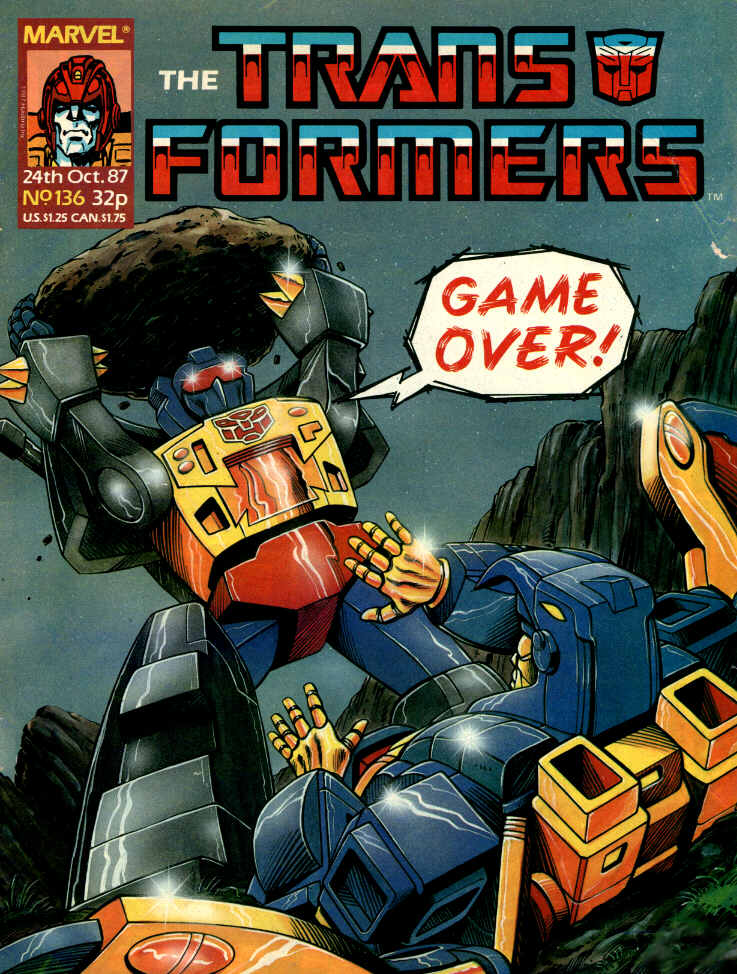
Bish's Review: Marvel UK #136 "Grudge Match!" Part 2

Grudge Match! Part 2 was written by Simon Furman, drawn by Jeff Anderson, inked by Stephen Baskerville, coloured by Steve White and lettered by Annie Halfacree.

Robin Smith provided the cover, which depicts a moment from the story where Grimlock nearly brains Divebomb with a boulder. It gets the job done but isn't an especially inspiring image. Grimlock is rather squat and rounded. I understand this is for perspective purposes, so we can have a dramatic angle, but I think Smith takes it too far. Divebomb, what we can see of him, seems nicely detailed however, even done to screws on the backs of his wings. Certainly not the worst cover but hardly memorable either.

Part 2 opens with Swoop being kicked around by the Predacons. They aren't really interested in killing him. They clearly have the upper hand so are just enjoying his anguish for now. Just as Razorclaw goes to to pick his sword up a massive metal foot comes down on it and he turns, in surprise, to see Grimlock's hulking dinosaur mode. The Dinobots have arrived!

Swoop is dismayed, knowing that if the battle goes on too long, the truth about his past with Divebomb will come out. Of course, Grimlock is only too happy to help his team-mate and the Dinobots go about their work with gusto.

Divebomb knows what Swoop is thinking and, smiling, taunts him with the possibility of revealing all. This goads Swoop into attacking him, restarting their battle and giving Divebomb the action he craves.

Grimlock, knocking Razorclaw about almost casually, mocks the Predacon leader and his team as Sludge, Slag and Snarl begin to get the better of their opponents.

Meanwhile, Swoop finds himself once again outclassed by Divebomb. Seeing Grimlock has bested Razorclaw he comes up with a plan. Choosing the angle carefully he dodges Divebomb's missile so that it strikes the ground near the Dinobot leader.

As Swoop correctly predicted, this enrages Grimlock who transforms to robot mode and cuts the low-flying Divebomb out of the air with his energo-sword. Swoop wants to be pleased that the Predacon is almost certainly going to die and therefore won't be able to reveal his secret but part of him is overwhelmed by the guilt of once again getting someone else to fight his battles for him.

Divebomb tries to spare his own life by spilling the beans to Grimlock but the Dinobot leader is unmoved. He reveals that he has known Swoop's secret for months, as since taking over the Autobot leadership he has had access to all of Optimus Prime's unlogged reports. Divebomb doesn't understand why Grimlock hasn't confronted Swoop about his lies but Grimlock simply tells him that Dinobots look after their own and threatens to smash him with a boulder.

Swoop runs over and stops him at the last minute saying that it's time he stopped letting others fight his battles for him.

In the end, the Dinobots let the Predacons go, with Swoop determined to fight the battle on even terms next time. The Predacons are battered and cross, all except for Divebomb, who cannot contain his glee that his old rival, and playmate is back!

I wrote last time about the nostalgia I have for this story and to be fair I think the story itself holds up but there are a couple of issues with it:
Primarily it's a very straightforward and well-written fleshing out of Swoop and his relationship both with Divebomb and the other Dinobots and on this basis I cannot recommend it highly enough. The twenty-two pages, the length of only one of the US issues, tell a clear arc with some decent action and solid character development.

On the other hand, there are some oddities that I find hard to ignore when it comes to the bigger picture. The biggest one is that Grimlock doesn't really feel like the character from the US comics. Which characterisation is preferable is certainly up for debate, in fact, I'd lean rather more towards Furman's version, but it is an inescapable fact that they do not read like the same individual, which is a problem in an ongoing comic, and, in all fairness, Budiansky got there first. It can perhaps be rationalised by suggesting that Grimlock is a good leader of the Dinobots but a terrible leader of the Autobots because he treats them like Dinobots who didn't make the grade, but there are still clashes when you compare their speech patterns and level of intellect.

Another somewhat questionable moment is the decision to let the Predacons go at the end of the issue. Thematically it makes sense but, much like observing their deprivations but not actually stopping them in Part 1 it seems like an odd move. If the Autobots are willing to do this sort of thing perhaps it's no wonder the war has gone on for so long. Then again, savage as they are, the Dinobots are perhaps the most willing group to do something like this over a matter of honour.

Another disappointment is that despite Divebomb's joy at the end of the story, this theme would never actually be revisited. That isn't a slight on this story, of course, but it feels like a shame, because the stage seems set for future conflicts between these two. Perhaps Furman couldn't make it work, or just found that he had too many balls in the air by the end of the comic.

Anderson's work continues to delight. He struggles a little to keep Grimlock's rather awkward dinosaur mode anatomically correct in the fight scenes but can be forgiven for that as almost no other artists can do it properly. The Dinobot leader just fundamentally lacks the articulation to fight properly and more modern versions of the character have tended to redesign this mode quite considerably to get over this problem. Other than that the whole issue is crisp and high quality. Divebomb is a very good design, particularly the sunglasses look of his optics, and there are a number of good panels of him. Due to the frenetic production time it is actually quite unusual to see two consecutive issues by the same art team in this comic and the consistency definitely enhances this particular story.

(Interesting sidenote: the backup strip in these issues was still the ongoing saga of the Headmasters mini-series, ultimately a much more important story for the future of the book.)

Apologies for the lateness of this review. In an attempt to get back on schedule I will be reviewing another issue this Friday. Stand by for Ladies Night!

Death’s Head Review: Issue #10 – The Cast Iron Contract

The final issue in the Death’s Head series has the same creative core as the one that started it: Simon Furman writer, Bryan Hitch artist and Annie H letterer. Steve White was editor and Euan Peters takes on colouring duties.
The cover is another superb Hitch/Farmer collaboration: amid rubble, smoke and flames, the Iron Man of 2020 stands victorious over a decapitated Death’s Head, holding up his head. It’s one of the more action-orientated covers, and Iron Man is very menacing, though his posture seems a little awkward. Death’s Head looks suitably expired (worryingly so, for an end-of-series issue), and there’s even red fuel/oil leaking from his felled body, adding some gore.
The only complaints I have are with the dialogue: Iron Man proclaims “There’s only one Iron Man … and I’m it, yes?”. As with Issue #6, the joke is repeated within the pages. Also, if the cover was being played for laughs (and they usually were), it seems funnier to have Death’s Head’s disembodied skull speak the final line as a cheeky response.

The opening page is a splash of Arno Stark, the Iron Man of 2020, looking even nastier than he did on the cover. Bullets are zinging off his armour as he leaps down into the streets of New York (there’s also a fluttering Daily Bugle in the background with the headline ‘Horned Monster!!’, so we can assume Death’s Head has arrived).
Iron Man is attacking a group of armed goons, which he despatches with relative ease, even blowing up their retreating van to show he means business. The men he just saved – diplomatic emissaries – refuse his violent protection, saying there has been some mistake. The emissaries drive away, leaving Iron Man to his nagging doubts, “not again” presumably a reference to his previous defeat by Machine Man.
This entire scene was narrated with a conversation between two unseen observers. As well as providing some exposition on Iron Man, it reveals they staged the entire incident and duped Stark into participating. The scene moves to a mansion and we meet these observers: Chance, a rich middle-aged dilettante (complete with monocle, smoking jacket and brandy) and his refined Indian valet, Athey. Chance is a member of The Dicemen, an elite group who set up these real-life contests for their own amusement.

Chance is eager to manipulate Iron Man for a second time, prompting Athey to warn his master that The Dicemen only use players once, to prevent their actions being traced back to them. Nonetheless, Athey suggests an opponent: Death’s Head has just appeared on television, having captured a gang leader and is keen to correct the news reporter that he did it for the reward, not civic duty. Chance orders an immediate contest.
Before that happens, we see Death’s Head working on another case: in a Hell’s Kitchen hideout, a trio of kidnappers are waiting for their reward money. Instead they get Death’s Head, punching through a wall to quickly overpower them; including one who accidently shoots down a section of ceiling on his own head, and another who mistakes Death’s Head for a demon and becomes paralysed with fear: “Il Diablo!” “Charming!”
Somewhat richer with the reward, Death’s Head returns to his offices, reflecting on his unexpected good fortune: 2020 is an even better market for his skills than 8162. And he’s even rid of Spratt. Athey is waiting for him, and offers a bounty on two ‘international terrorists’ (the diplomatic emissaries Iron Man is protecting). Death’s Head is distrustful, but accepts the job.
Later, Iron Man is still protecting his unwilling charges, bustling them into a hotel elevator. Before he can join them, he is shoved away by a mechanoid hand and the doors close in his face, leaving Death’s Head alone with his prey. Iron Man tears off the elevator roof and the two battle, almost severing the elevator cables in the process.
With a burst of righteousness, Iron Man barges into Death’s Head, rocketing them far away and slamming into a distant rooftop. Before the mechanoid can recover, Iron Man grabs his head and tears it off his shoulders. Alone on the rooftop (unaware that he is being watched by Chance) Arno Stark wonders aloud at why he needs this victory so badly that he won’t question all the suspicious elements of the job. Before he can go any further, he is tapped on the shoulder, and punched by the mechanoid’s headless body.

Then follows one of the funniest sequences of the series: Death’s Head’s body continues to deliver a solid beating to Iron Man, as the disembodied head sits among the rubble and grumbles away. “Ever had your head ripped off, huh? … Anyway, it hurts! Does nothing for one’s sense of humour.”
Once Death’s Head has finished letting off steam, he picks up right where Iron Man left off and they start comparing notes about their employer. Realising they have been deceived (Iron Man is personally angered, Death’s Head is concerned about the balance of his fee), they join forces and soon track down Chance’s mansion.
As his defences fall to their combined assault, Chance turns to Athey – only to find his valet pointing a pistol at him. Athey explains that he really serves The Dicemen Council, which Chance has jeopardised by breaking the rules. Shooting his employer, Athey departs as Iron Man and Death’s Head burst into the study. They find the dead Chance, the remainder of their fees and a mysterious set of dice. Before they can investigate further, they have to fly away as the house explodes.
Safely clear, the two depart with a handshake and Death’s Head offers some words of advice to the troubled Iron Man, “Be sure of yourself, huh? Everything’s straightforward when you believe in what you’re doing. Strike fast, take the money … and don’t lose your head, yes?” It’s a neat summation of what makes Death’s Head such an enjoyable character to follow, so makes for a good closing note of the series.

But before things come to an end, we get a two page epilogue (narrated in a cute, fairy-tale style). Death’s Head sees his spacecraft fly out of a dimensional portal, crash-land and disembark a distressed Spratt and vulture. As Death’s Head bemoans their arrival, out leaps another passenger: Big Shot. The bounty hunter has come for revenge, claiming that, “She sent me here to destroy you!”. The caption assures us that they would live, “happily ever after!”
And so the Death’s Head series ends on a strong note (two strong notes, if you count the epilogue). A good plot, a solid antagonist, lively action and some nice humour.
The guest star was well-chosen: Iron Man of 2020 gets to develop as a character, but not at the expense of Death’s Head. Being a fellow mercenary, albeit with a hint of morality and a lot more self-doubt, he teams up nicely with the mechanoid.

Stark’s backstory is only hinted at, and could perhaps have been laid on heavier since it is relevant to his behaviour (the Machine Man series and the Spider-Man annual was featured in the Transformers UK comic, so perhaps Furman was counting on the likely readers having prior knowledge). It’s great that Death’s Head is able to contribute to someone else’s growth (rather than just passing by the Fantastic Four, or being lectured by Doctor Who) and makes this the most satisfying guest issue. In terms of the Marvel universe, Arno Stark is just as peripheral (if not more so) as Death’s Head – so perhaps that gave Furman more freedom as a writer.
The story is well paced. In the scene that introduces the two antagonists, we get some nice mirroring of Iron Man and Death’s Head: one is violent and plagued with doubt, the other cool and efficient. Once united, they do seem to counter-attack remarkably quickly, and the last few pages do rush along – perhaps this is another issue that would have made a good two-parter.
Treacherous employers Chance and Athey are pitch-perfect as decadent gamesmaster and his faithful manservant. The Dicemen Council was also an interesting idea that could have been developed into a 2020 antagonist, had the series survived. Athey’s betrayal is signposted in thought bubbles, although I prefer the subtler clue when the impeccable valet delivers a warning using his master’s first name, breaking all rules of domestic service. In many ways, the set-up is a repeat of Dogbolter and Hob – only much more satisfying, not least because Death’s Head immediately senses duplicity and manages to turn the tables using his own wits.
Bryan Hitch’s artwork, as always, is first-rate, although he does seem to have gone a little heavy on the inks. I’d say Hitch’s pencils were best complimented by Mark Farmer’s inks, and it’s a shame that, after Issue #1, they only worked together on the covers.
That wraps up the Death’s Head series. For the most part, it was an enjoyable read, but I think the title nonetheless failed to live up to its potential. At the time of launch, Death’s Head was a strong and versatile character (with an established Transformers fanbase) yet the series seems to have meandered, never managing to hit a constant stride (not least because over 40% of its content was given over to guest appearances, and it accommodated a number of different artists). I’m surprised that Furman seemed to have such a loose grasp on the series arc, especially when the sister-title Dragons Claws wrapped up neatly, despite also falling prematurely under the axe. Perhaps once Dragons Claws folded, the idea of an 8162 universe was abandoned, and the final issues were just meant to launch Death’s Head as a perennial guest star.

Looking back, the stories that worked best were the ones that allowed Death’s Head to take centre-stage, glorifying in his amorality and sardonic wit. I’m still surprised that the internal monologue was dropped after a few issues, and though I have no real objection to Spratt, I don’t think he added much as a sidekick that a client (like Thea) or ally (like Iron Man) couldn’t have provided.
According to the foreword in the collected works, the title closed down for distribution reasons, so no matter what changes were made, I think the series was always doomed. However, it did provide some memorable stories, strong action pieces and a good few laughs. It certainly built on the foundations of a memorable character, with the potential to cross over into any other title, yes?
The series may have been over, but it never ends! Next week: we get a taste of Death’s Head’s origins and find out what that epilogue was all about. Part one of the stunning graphic novel: ‘Hunters’.
Death’s Head #10 was republished ‘Death’s Head Volume 2